
- JTEKT TOP
- Sustainability
- Environmental Report
- Products and Technologies
Products and Technologies
The impact on environment by using product is deeply related to product development and design. Therefore, companies have a responsibility to engage in development and design that takes everything into account from sourcing materials to the use and disposal of products by customers.
JTEKT contributes to environmental preservation activities and aims to realize a sustainable society by developing technologies aimed at reducing environmental impact during product use and manufacturing processes, managing environmentally hazardous substances contained in products, and utilizing recycled materials and designing products that are easily recyclable.
Main FY2024 results


Results evaluation_Environmental Action Plan 2025 and Activity Results 2024
| Classification | Initiative Items | Target and initiative policy | FY2024 Activity Results | Assessment | |
|---|---|---|---|---|---|
| Products and Technologies | Development and design of environmentally friendly products | (1) Development of new technology and products that promote environmental impact reduction of top runners | Deploy the environmental efficiency formula established by JTEKT to each group company, aiming to improve the assessment of our products as All-JTEKT |
|
◯ |
| (2) Promotion of 3R (reduce, reuse, recycle) design with consideration for effective use of resources | 1. Prompotion of the product design easily recyclable 2. Reduction of resource and energy consumption by downsizing, weight-saving, and lengthening product life |
|
|||
| (3) Management and reduction of environmentally hazardous substances contained in products | Promotion of global chemical regulation compliance and establishment of management |
|
|||
| (4) Deployment of environmental assessment at the design and development stages | Promotion of environmentally friendly products through environmental assessment at the design and development stage |
|
|||
| (5) Contribution to CO2 reduction by products | 1. Reduction of CO2 emissions by switching to environmentally friendly products 2. CO2 reduction contribution from product use shall be at least 165K-ton by FY2025 (Global single-year CO2 reduction contribution) FY2024 target: 149.2K t-CO2 or more |
||||
Activity report
Environmental Conservation Activities by the Environmental Responsive Products Subcommittee
The Environmental Responsive Products Subcommittee has formulated a roadmap for achieving the 2030 CO2 reduction target and is promoting the development of environmentally friendly products based on this roadmap. In particular, they have introduced a system to visualize CO2 emissions at the product development stage, and are making efforts to reflect miniaturization, weight reduction, higher efficiency, and reduction of materials used in the design.
Governance of the management of chemical substances in products
We have established a management system for chemical substances contained in products centered on the "Product and Environment Committee", which is chaired by the Chief of Business Field from Research and Development Division. The committee meets twice a year to clarify issues and set targets based on company policies, discuss and decide on the appropriateness of measures, and manage progress.
In addition, seven working groups have been established under it with their respective roles, which promotes activities by clarifying the division of roles and responsibilities, such as formulating company-wide policies for the management of chemical substances in products, establishing domestic and overseas systems, internal and external education/audits, and promoting design changes and product switching when chemical substances in products are changed.

Major initiatives in the Product and Environment Committee
The renewal of the fundamental rules and regulations in FY2023 and their dissemination both internally and externally have enabled us to respond smoothly to investigations in the event of possible nonconformity with the standards, thereby minimizing the impact on our customers. In addition, through the implementation and dissemination of the new regulations, we continuously worked to identify and improve new issues, including the followings.
First, to improve the system, we created a list of purchased products that complies with the latest laws and regulations for secondary materials distributed with products, distributed it to production sites, and established operational rules. This list is managed centrally to ensure a uniform and high level of control across all plants.
We are also promoting the strengthening of internal audits with the aim of raising awareness and fostering a corporate culture within the Company. By expanding the departments subject to audit and using improved check sheets for quantitative evaluation, we are raising the level of management.
Furthermore, to strengthen the management system for the entire supply chain, a briefing session on management methods was held for suppliers in July, and individual understanding activities and support continue as needed.
In order to continue providing safety and security to our customers, the JTEKT Group is united in strengthening our management system and aims for sustainable corporate activities.
Contribution to CO2 reduction by products
In FY2024, we worked to reduce CO2 emissions through further weight reduction and energy saving initiatives. However, due to a decrease in product sales volume, the amount of CO2 reduction contribution was only 339Kt, lower than the previous year. Although we have already achieved the FY 2025 target set in 2021, we will continue our initiatives to further reduce CO2 emissions.

*Contribution to CO2 reduction by products is the amount calculated globally in a single fiscal year.
Assessment method
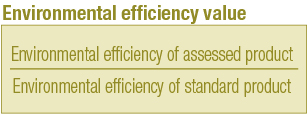
In order to make the environmental load reduction effect of our products evaluated numerically, we have established its basic formula for environmental efficiency as our own index. The higher the value, the greater the environmental impact reduction. Therefore, we set the target of a higher environmental efficiency value each year, and work on product development while evaluating the degree of achievement.
- Basic formula for environmental efficiency and environmental efficiency computation
Environmental efficiency is a value calculated based on the degree of lightness, compactness, energy-savings, etc. The environmental efficiency value is calculated by dividing the environmental efficiency of the assessed product by that of the standard product. - Computation of environmental load reduction effects
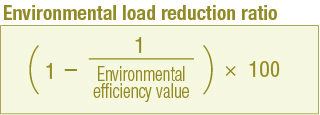
Environmental load reduction effect is determined by calculating the environmental load reduction rate from the environmental efficiency value. For example, if the environmental efficiency value is 1.25, the environmental load reduction effect of the product is 20%, and the reduced environmental load is calculated as the reciprocal of the envirnmental efficiency value.

Initiatives for environmental design activities
JTEKT is promoting environmental design activities through the concerted efforts of each business division and group company. With such ingenuity from the design stage, the JTEKT Group's products contribute to the global environment.
【JTEKT's initiatives】
JTEKT Corporation : Industrial and Bearing Business Unit
Contribution to Fuel Efficiency and CO2 Emissions Reduction through Mass Production of LFT-V
JTEKT developed the low-torque tapered roller bearing LFT🄬*2 in 1983 for use in automobile transmissions and differential*1 pinion supports.
Since then, we have continued to provide solutions to low-torque needs through making improvements such as applying special crowning shapes to the inner and outer ring raceways and controlling the amount of lubricating oil that flows into the bearing. And the latest LFT-V bearing in the series, developed in 2020, offers further solutions to the mobility industry by reducing loss torque by up to 15% and improving low temperature rise performance compared with LFT-IV bearing through optimization of the resin retainer cage.
This product is adopted in Isuzu Motors Limited's new model 'MU-X' and will be mounted on the rear differential. The low torque performance of LFT-V will contribute to improving fuel efficiency and reducing CO2 emissions of the new MU-X.
*1:Differential is a device that absorbs the difference in rotation between the left and right wheels when turning a car.
*2:LFT🄬 is an abbreviation for Low Friction Torque, a registered trademark of JTEKT
<Effect of initiatives>
Reduction of loss torque by up to 15% compared with the conventional product (LFT-Ⅳ)
By optimizing the shape of the resin cage and optimally controlling the inflow of lubricating oil, this product has achieved the lowest torque in the series, reducing lost torque by up to 15% less torque compared with the conventional product (LFT-IV). In addition, by providing a groove in the cage pocket to retain oil, the resistance to seizure at start-up and at low temperatures is improved. In view of the recent trend toward lower viscosity oil and lower oil volume, the oil flow inside the bearing is optimized, which in turn can also reduce the temperature rise of the bearing.

In our LFT series
| Item | Compared with LFT-IV |
| Loss torque | Up to 15% reduction |
| Bearing temperature rise | Up to 10°C reduction |
Starting with the start of mass production, we will contribute to improving the fuel efficiency of automobiles around the world with LFT-V, and contribute to achieving carbon neutrality by reducing CO2 emissions through reducing energy loss in all forms of mobility, including industrial machinery.
【JTEKT Group's Initiatives】
JTEKT FLUID POWER SYSTEMS CORPORATION
"Energy-saving performance No.1 - Ultra Low-Power Solenoid Valve HD1E series"
JTEKT FLUID POWER SYSTEMS CORPORATION is working towards improving the efficiency of hydraulic system pumps, motors, and control valves installed in production equipment, focusing on energy saving tailored to various applications such as pressure accumulation control, electric oil HEV, and idle stop systems, to ensure that necessary tasks can be carried out when needed. We are also expanding our series of hydraulic systems to meet diverse needs. This product is a solenoid valve for industrial machinery, mainly machine tools.
This product is a solenoid valve for industrial machinery, mainly machine tools. As there is a growing need for energy-saving plant equipment in order to achieve carbon neutrality, we have achieved a 30% reduction in power consumption compared with conventional products while maintaining the performance of an electromagnetic switching valve, achieving the industry's highest level of 3.4 W. The amount of CO2 reduction is equivalent to 1.3 t-CO2/year per 100 units of equipment. The solenoid switching valve is a directional control valve that controls the direction of oil flow by solenoid excitation, and has achieved significant energy-saving performance by improving efficiency and optimizing pull force characteristics by a thorough review of the magnetic circuit. Moreover, the mass has been reduced by 8% by reviewing the solenoid structure.
<Effects of Initiatives>
Power consumption reduced by 1.2W (30%) compared with conventional products
In order to reduce power consumption by 30% compared with conventional products, (1) improvement of magnetic efficiency by reviewing the structure between parts based on magnetic field analysis, and (2) optimization of attraction force characteristics according to the applied load by reviewing the shape of the suction surface of the movable iron core can reduce power consumption by 1.2 W and contribute to energy saving of machine tools.
In addition, this product received the FY 2024 "Japan Chairman's Award" from the Energy Conservation Center for the Energy Conservation Grand Prize in the Product and Business Model category.


We achieved an industry-leading 3.4W and reduced power consumption by 30%.
Our company will continue to develop products with consideration for energy and resource conservation, working towards reducing environmental impact.
JTEKT THERMO SYSTEMS CORPORATION
"CN Retrofit Service"
This service is a retrofit service aimed at reducing energy loss in metal and industrial heating equipment such as heat treatment furnaces, and it received the FY 2024 "Japan Chairman's Award" from the Energy Conservation Center" at the Energy Conservation Grand Prize.
It is said that heat treatment equipment accounts for approximately 20% of the total energy consumed in plants. There are approximately 40,000 heat treatment furnaces and other metal and industrial heating equipment in Japan, and our company has a large sales record.
However, due to the aging of equipment and other factors, in batch furnaces used for metal heat treatment, only about 20% of the energy is effectively utilized for the heat treatment of products, while the other 80% results in energy loss.
Our company is working to halve this energy loss and contribute to activities aimed at achieving carbon neutrality.
<Effect of Initiatives>
Energy loss in batch furnace reduced by 1/2 (40% of total energy loss)
We implemented the following three measures for the equipment currently used by customers, and were able to obtain results from each of them.
1. Reduction of endothermic gas (N2 shots)
Endothermic gases required for carburizing process were reduced by reviewing the introduction pattern.

2. Improvement of furnace heat insulation (Super Moldatherm)
By using our newly developed high-performance insulation material, Super Moldatherm, and porous insulation boards, we improved thermal insulation performance, which reduced heat dissipation and allowed us to decrease the heating chamber power.

3. Optimization of quenching oil temperature control (QEC)
By improving the cooling pattern of the quenching oil after quenching, we were able to minimize the oil tank holding power and reduce the oil tank power consumption.

40% reduction in overall energy use
Although the effect will vary depending on your operating conditions, we estimate that the three modifications together can provide up to a 40% reduction in overall energy use.
Our company will continue to develop products that conserve energy and resources to reduce environmental impact.
